
Writing on oceans, culture, and the public good.
Sebastian writes about ocean conservation, youth leadership, civic institutions, environmental responsibility, and the relationship between people and the natural world. He’s been a contributor to national and local publications including Huff Post, The Salt Lake Tribune, and The Park Record. Read below.
For Marine Species, Hidden Divisions Abound
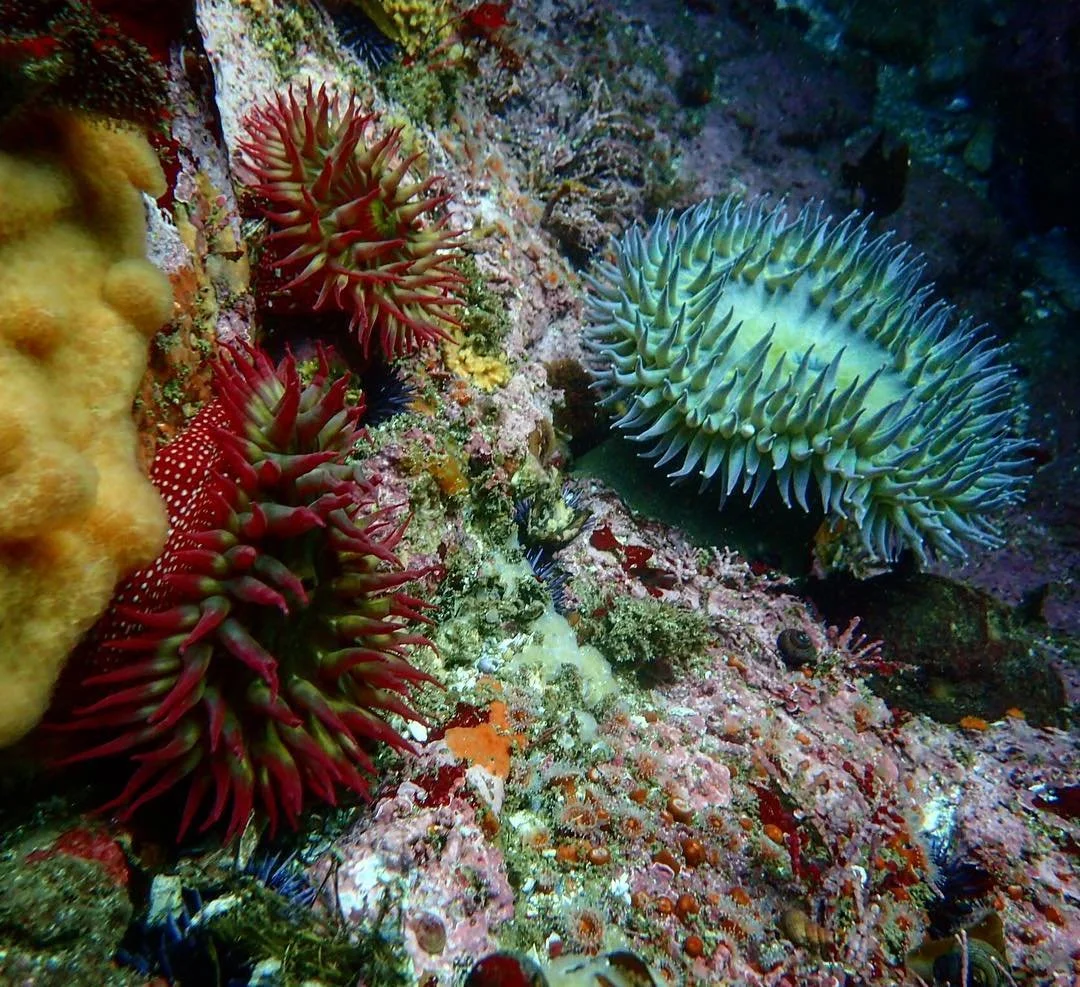
The little sand lance is unexpectedly split in two, revealing a breadth of genetic diversity that could help it survive.
This article was written by Brian Owens and edited by Colin Schultz for publication in Hakai Magazine on February 24, 2023 at this link. The article quotes Sebastian Nicholls.
On land, rivers and mountain ranges can divide species into genetically distinct populations. In the vast expanse of the ocean, where there is seemingly little to stop fish and other sea creatures from going where they please, scientists have long expected marine species to find it easier to mix. But ongoing research shows there’s more than just geographic barriers keeping populations separate, and marine species often have a higher genetic diversity than anticipated.
Hannes Baumann, a marine scientist at the University of Connecticut, says that for years the prevailing notion was that species in the ocean didn’t form separate populations. “But the last 20 years has demolished that concept,” he says. “Now everywhere we look we see differentiation.”
Protecting that genetic diversity is a focus of conservationists. At a recent meeting of the United Nations Convention on Biological Diversity (CBD), the agency’s members adopted a new framework setting overarching goals for conservation efforts, including preserving genetic diversity within species to safeguard their ability to adapt to changing conditions.
“Genetic diversity is especially important for resilience,” says Sebastian Nicholls, from the Pew Charitable Trusts’ ocean conservation program, which works closely with CBD member states to help them meet their commitments on marine conservation issues. “If there is too little diversity, a species may be susceptible to a single pathogen or environmental stressor.”
A strong example of the value of that diversity comes from the recent discovery by Baumann and his colleagues that the northern sand lance, an important forage fish, is actually two populations.
By sequencing the genomes of hundreds of northern sand lance living from Greenland to New Jersey, the scientists found that the fish population is split in two—one group dwells north of the Scotian Shelf, off the east coast of Canada, and one lives farther south.
There is something curious about the Scotian Shelf, says Baumann. No obvious barrier prevents fish from crossing the divide and mixing with their neighbors, but it seems that their offspring do not survive when they do. Baumann suspects a change in water temperature centered around the shelf is to blame—the southern waters are too warm for the cold-adapted northern fish, and vice versa. The shelf also separates populations of other species, including lobsters, scallops, and cod. “This confirms with yet another species that the Scotian Shelf is almost a universal genetic barrier,” says Baumann.
More than a curiosity, the genetic minutiae of this little fish is surprisingly important. Sand lance are a cornerstone of ocean ecosystems. Just about everything eats the slender forage fish, including 72 species of fishes, birds, and mammals.
Theoretically, the existence of a population adapted to warmer water should help the species weather the stresses of climate change because it is more likely to thrive and spread northward as the ocean warms. But that doesn’t mean we should give up on their northern neighbors, since other unique adaptations could become important in the future, Baumann says. “Even if we don’t know which variant is the important one, we need to preserve all of them.”
The problem is, scientists know very little about the genetic diversity of most marine species, especially in the deep sea, says Nicholls. Many marine ecosystems are remote and difficult to get to, making it challenging to understand what diversity actually exists. “We don’t really know what’s out there; we’re discovering new species all the time,” he says, “so it’s even harder to get information about genetic diversity.”
Nicholls says the best tools to preserve both the genetic diversity we know about, and that which we don’t, are strong networks of marine protected areas. At the CBD meeting, members also agreed on a target of protecting 30 percent of coastal and marine areas by 2030. “If we protect enough of the ocean, populations can replenish themselves and spill over into adjacent areas, maintaining diversity both within and outside their boundaries,” Nicholls says.

Millennials Rise on Earth Day to keep Marine Life Afloat
“The future of the ocean, I’d leave a question mark, without a word. Because that … depends on what [young people] push the world to do.”
This article was originally published on Huff Post at this link on May 5, 2017 and updated on Oct 22, 2017.
This Earth Day, April 22nd, the Sustainable Oceans Alliance held its third Annual Sustainable Oceans Summit, with a theme of making the ocean “famous.” The event drew hundreds of participants and was live-streamed through a generous grant from the Walton Foundation. Viewers tuned in live from Peru to South Africa.
The Sustainable Oceans Alliance (SOA) and McCourt E&E held the event to highlight the importance of healthy oceans to all life on Earth. On Earth day, the Summit aimed to #MakeTheOceanFamous to highlight the importance of the ocean on our blue planet. Most of Earth’s surface is covered by water, and the biogeochemical cycles that produce oxygen, store carbon, regulate climate and sustain life on Earth depend on a fragile ecological balance in the ocean that teeters on the edge.
The Summit’s social media campaign using #MakeTheOceanFamous was amplified over 500 times Saturday, including tweets from Senator Sheldon Whitehouse, the UN Office of Projects and Services, Conservation International and the XPrize Foundation among others. Tweets using #MakeTheOceanFamous reached an audience of 1.32 Million Twitter users.
Summit speakers focused on raising awareness and emphasizing solutions. While the situation of the oceans is dire, speakers and participants did not dwell on problems; rather, they highlighted solutions and reasons for hope. The idea that we can restore the ocean was a common thread throughout the program.
Dr. Greg Stone’s talk discussed the upcoming technology revolution and its promise to solve complex conservation challenges. He took participants through ancient history, to the ocean’s situation today, making the case that young people and new technology can drive an ocean renaissance. The ocean renaissance could both bring life back into the ocean, and reconnect humanity to the sea. "You can find evidence of humans in the ocean since the 200,000 year mark" Dr. Stone said, underscoring the deep connection we have to oceans, “The ocean saved us hundreds of years ago and it has to save us again.”
National Geographic Explorer Dr. Enric Sala illustrated the regenerative ability of the ocean, using the example of a marine reserve in the Mediterranean. An area of only 1 square km has been protected in the Islas Medes reserve for 20 years. It now contains marine life no longer found in most of the Mediterranean. No-take marine reserves allow the ocean to replenish itself, and contain greater biodiversity and larger animals than surrounding waters. “When you don’t take out the fish, they take longer to die” Sala noted with a chuckle.
Asked by a student interviewer for a word to describe the future of the ocean, Sala spoke about the ocean’s wonders, but then noted that the words danger and urgency describe the present of the ocean due to “too much fishing, pollution, [and] climate change”. He went on “But the future of the ocean, I’d leave a question mark, without a word. Because that word depends on what you guys push the world to do.”
Maggie Thompson, the Executive Director of Generation Progress echoed Sala’s call to action powerfully, emphasizing the potential for meaningful change through engagement. Speaking about Millennials on ocean issues and climate change, Thompson said: “We’ve got numbers on our side…we have a body of peers that’s coming up. And if we engage them and mobilize them on this issue… we are going to be incredibly powerful.”
Millennials are heeding the call and taking action to change the status quo. One participant, A student who traveled from New York to attend the summit, left inspired to make a difference. She is nearing the end of her studies in civil engineering at Columbia this May, but wants her engineering program to incorporate sustainability. “I realized there are so many threats; and yet we’re not considering these in design or in the education of the next generation of architects.”
After the summit, she reached our to her program’s Department Chair at Columbia and has had discussions on how to incorporate sustainable design principles in Columbia’s civil engineering program. She was particularly inspired by the breakout session led by William McDonough on Cradle to Cradle design, where he underscored the principles of a circular economy and the urgency of adopting that model, noting the toxic effect dominant economic models have on human health and the environment. “We have targets to do less bad, but doing less of something bad doesn’t connote doing good.” McDonough noted.
Another group of Georgetown students featured at the Summit is developing technology to prevent plastic microfibers from flowing from washing machines into our waterways and the sea.
In the afternoon, speakers focused the power of creative thinking, technology, and innovation to solve previously intractable issues. Julia Roberson, VP of Communications for the Ocean Conservancy walked through a strategy for communicating the threat of ocean acidification, as the audience took notes furiously to record her insights.
The afternoon program also included a panel on the Future of Sustainability and Innovation in the Private Sector moderated by Matt McGuire, former U.S. Executive Director of the World Bank. The Director of UNOPS, Grete Faremo, Head of Citi Environmental Finance Michael Eckhart, CEO of Playmob Jude Ower, and founder of We Are The Oceans (WATO) Daisy Kendrick discussed opportunities for innovation, tech and creative thinking to create a sustainable future. Eckhart and McGuire discussed restructuring finance to enable sustainability, sharing insights that Faremo echoed: "It's about sharing risk to develop solutions that give better results."
WATO Founder Daisy Kendrick and WATO advisor Jude Ower described their strategy to engage on oceans. “We are the most connected generation in history” Kendrick noted, but “First we need to educate and today we are doing that through gaming.” Ower has been critical to the development of gaming as part of WATO’s engagement strategy, bringing experience and insight to the table as founder and CEO of Playmob, a gaming company which aims to raise $1 Bn for charitable causes.
At the summit, WATO launched its new game “The Big Catch” which features an endangered Vaquita porpoise cleaning up the ocean. WATO, UNOPS, and SOA hope that in addition to helping reduce plastic use, the game might also help save this critically endangered species—of which fewer than 30 individuals are left in the wild. The game is part of a larger push to bring youth into the fray on ocean issues, an interest that SOA, WATO, and UNOPS share. "We need to bring youth on board, leverage partnerships & push for inclusion to preserve oceans” Grete Faremo noted, “This is about not leaving anyone behind.”
The final keynote of the Summit started on a sober note, describing the ocean today as “unhealthy, unappreciated and unknown.” But Dr. Paul Bunje, the Chief Scientist of the XPrize Foundation believes it doesn’t have to be this way. “If we embrace exponentials, pay for success, and empower the crowd, the ocean can become healthy, appreciated, and understood.”
“This is what SOA is about” Daniela Fernandez, founder of SOA said, “enabling innovation and youth involvement to change the status quo. We’re growing SOA to make these issues mainstream concerns—because our survival depends on it. The world needs youth to rise up.” Change could not come soon enough to save oceans, struggling to keep life afloat. Gladly, hundreds of millennials signed up to the fight on Earth Day.
Youth Chart New Course to Disrupt Our Ocean's Future
The time to sound the alarm is long past; now, the next generation must either chart a new course to the future we imagine—with prosperity enabled by a healthy sea--or be left adrift, facing uncertain winds and a future that might threaten human life itself.
This article was originally published to Huff Post at this link on Jun 16, 2017, 10:46 AM and updated Aug 2, 2017.
Last week, world leaders gathered at the United Nations Headquarters in New York for a high-level forum on ocean sustainability. The message was stark: the crisis of our oceans requires leadership and innovation, and leadership cannot be left to political leaders alone. Rather, the changes required to enable continued prosperity on a healthy blue planet require cooperation between business, scientists, civil society, and governments to drive systems change. We need to change the way we as a species relate to the natural environment on which we depend.
The ocean has suffered overfishing, warming waters, nutrient and debris pollution, rapid acidification, and changes in circulation that might have wide ranging impacts on the global climate. That’s why I have been raising awareness and empowering youth to create the business, policy and advocacy initiatives that will restore life at sea. In a rapidly changing planet, the work of the Sustainable Oceans Alliance is now more critical than ever
We are convinced that young leaders can challenge the status quo and enable the billions of people who depend on the ocean for food or income to have a brighter future. Equal opportunity is not possible if we allow the most vulnerable to suffer the consequences of a changing climate and of overfishing by long distance fleets funded by distant nations.
It was heartening to see and hear world leaders –led by the President of the General Assembly, Peter Thomson, Deputy Prime Minister of Sweden Isabella Lövin, and Prime Minister of Fiji, Frank Bainimarama heed the call to protect our blue planet. I attended the UN Ocean Conference, along with a youth delegation which met former presidents, emerging business leaders and NGOs to discuss the solutions needed to restore life in our global ocean. Youth participation in these discussions brings a fresh perspective and new energy to create solutions.
The time to sound the alarm is long past; now, the next generation must either chart a new course to the future we imagine—with prosperity enabled by a healthy sea--or be left adrift, facing uncertain winds and a future that might threaten human life itself.
In our conversations, we found hope. President Grímsson of Iceland presented policies that reduced waste in Iceland’s fishing industry. Wybe Bruinsma, CEO of Van de Sant, spoke of his company’s integration of ocean plastics into its supply chain, and its fully recyclable furniture.
Nishan Degnarain and Dr Gregory Stone, Chairs of the World Economic Forum's Special Initiative on Oceans, expressed their enthusiasm for a vision of involving youth in tackling ocean conservation challenges. In their newly published book, Soul of the Sea in the Age of the Algorithm, they present a manifesto where new leadership for our oceans may lie with youth and technology startups, who can challenge norms, rethink business models, and develop radically new policy innovations at a 'systems' level.
They refer to the potential of the 'Fourth Industrial Revolution' and how new technologies will drive our next uses of our oceans, and this requires major shifts in our value systems and technological solutions to achieve impact at scale.
Youth, with unbridled creativity and determination, and unencumbered by assumptions of “how things work” can and must create that change, to replace the current system. Often now, economic growth is parasitic on the environment and power structures enable suboptimal outcomes. We can accept that no longer.
That is why I will continue work in new countries and new areas—connecting a global network of young leaders to each other and to the mentors and leaders that can help make our vision a reality. The hope is to enable entrepreneurs to create sustainable and profitable alternative ventures, and continue to give youth the opportunity to participate in high level international fora—where they can learn from but also challenge leaders to create the change we need.
At the Our Ocean One Future Leadership Summit last September, co-hosted by the Sustainable Oceans Alliance and the State Department, then Secretary of State John Kerry told 150 young leaders from more than 50 countries “I don’t think this is an end. I think this is a beginning. And I think we are going to, all of us, share a new voyage of environmental stewardship, environmental leadership, and we are going to be informed by unassailable science. We’re going to be driven by an awakened and global constituency. We’re going to be motivated by the fact that when the very health of the planet is at stake, delay, denial, and neglect have no place on the agenda.”
When some in power make denial and neglect their policy, they’ll find assiduous opposition from us, the next generation. We are the awakened and global constituency, and our time has come. Young leaders at the UN Ocean Conference are a start, but only the beginning—we will continue to lead the voyage to a prosperous future on a healthy blue planet. The businesses we create, innovations we drive in policy and governance, and our rethinking of power structures will open a future of oceanic opportunities.
Celebrating a Living Ocean of Wonder
Let’s reflect on the importance of the ocean to our own life, not just for enjoyment and inspiring awe, but for our survival.
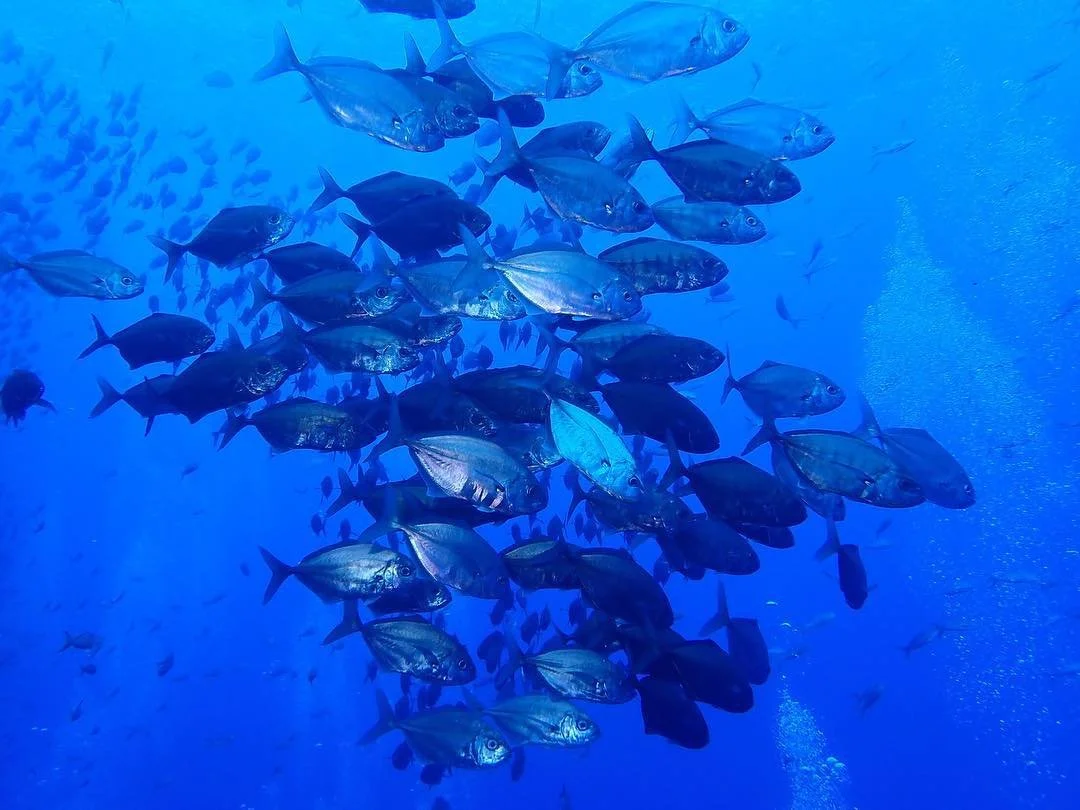
Imagine a planet where 90% of the habitable space is unexplored, where launching expeditions into that uncharted territory almost always yields new species and insights, and where the unique features and isolation of a dark world harbor plants and animals that bend the rules of life itself. Now take a breath—half of the oxygen you just inhaled comes from that dark, uncharted realm. The planet is Earth, and the dark realm is our ocean.
What’s out there is astonishing— from fish with transparent skulls, to octopi that flap fins near their head to glide through the sea (aptly named the Dumbo Octopus). Animals in the deep ocean light up in dazzling displays of bioluminescent color. The depths of the sea contain entire ecosystems that never see the light of day. But beyond the wonders of the deep and other mysteries of the sea— the migrations across entire oceans that fish, cetaceans and reptiles undertake, symbiosis and solidarity between species, and the fascinating diversity of marine life—we should pay attention to the ocean for a more basic reason: it makes life possible.
If you’ve taken more than one breath in your life, you’ve depended on the ocean to survive. If you’ve ever eaten food that took rainwater to grow, you’ve depended on the ocean for nourishment. If you’ve enjoyed mild weather, you’ve witnessed the ocean’s gift to Earth.
The ocean gives us half the oxygen we breathe, and redistributes heat through ocean currents that stabilize the climate. It also absorbs most of the extra heat trapped by our atmosphere, and feeds or provides income to over a billion people. The sea is the source of almost all rainwater which falls on Earth and takes in all the minerals and waste that flow out from land through rivers.
If our bodies were a microcosm of the planet, the ocean would be our heart and blood, our lungs, kidneys, food source and fever prevention system. All the vital functions of the planet are executed or supported by the ocean, its “blue heart.” Those functions are enabled by a delicate balance, an intimate connection between biological, geological, and chemical cycles in the ocean. The biogeochemistry of the ocean enables life on our blue planet.
The prefix ‘bio-’ in that word (biogeochemistry) underscores the importance of life to Earth’s life support system. A world of living wonder in the deep and in the shallows interacts with chemistry and geology to deliver the services provided by our ocean. Chemistry and geology contribute to our planet’s vital functions, but the ocean’s bounty is enabled by life, by a living ocean of wonder.
Trillions of plankton take in Carbon Dioxide and produce Oxygen—in aggregate, their movement is powerful enough to affect ocean circulation. Whales redistribute nutrients both from the deep to the surface and from higher latitudes to tropical waters. Androgynous fish bring back nutrients from the ocean to land, where they fertilize forests. The list goes on and on.
Every time we breathe, every time we feel rain on our skin, every time we eat or drink or just enjoy weather that’s bearable, we are connected to the sea. The ocean provides all this through an abundance of life, but its living systems are under threat. We should celebrate all the ocean gives to us. The World Ocean Festival, coming up on June 4th is an opportunity for us all to celebrate the living ocean of wonder that makes Earth a living planet.
Let’s reflect on the importance of the ocean to our own life, not just for enjoyment and inspiring awe, but for our survival. Let’s notice, as Dr. Sylvia Earle says, that “We should protect the ocean as if our lives depend on it, because they do.”
Sebastian Nicholls is the Program Director of the Sustainable Oceans Alliance, a global organization that empowers the next generation to become leaders in preserving the health and sustainability of our ocean. The Sustainable Oceans Alliance is a proud partner and supporter of the World Ocean Festival, a public event to #SaveOurOcean on June 4th in New York City that will include the first-of-its-kind Ocean March, a parade of large and small boats on the water as a statement of unity for the ocean. Learn more at www.worldoceanfest.org

In a Utah library, quiet progress on climate change
This article was published as a Special to The Salt Lake Tribune on Sep. 30, 2022, 9:00 a.m. and Updated: Oct. 5, 2022, 7:44 a.m. The original can be found at this link.
On September 26, at a modest auditorium tucked away in Salt Lake City’s Main Public Library, two congressmen and their opponents gathered for a climate discussion, striking for its divergence from politics as usual.
The discussion was civil, informed and pragmatic, focused on ways to move forward, with few of the partisan jabs that have become, to the detriment of our country and communities, expected of many of our politicians. This town hall was more remarkable still for facilitating a productive discussion on a topic that has been polarizing — climate change, and what we and our elected leaders can do to mitigate its accelerating and potentially catastrophic impacts.
Republican Reps. John Curtis and Blake Moore and their Democratic challengers, Glen Wright and Rick Jones, engaged earnestly, answering questions from local high school students. They talked about how they have personally felt the effects of climate change, what they have done about it in their personal lives and the challenges they see to crafting lasting, bipartisan policy solutions that sufficiently address the causes of climate change.
Though there were disagreements, candidates were respectful and even expressed appreciation of the perspectives shared by their opponents. Some of the candidates thanked the organizers, Citizens’ Climate Lobby, for providing the impetus and opportunity to deepen their knowledge about climate change and potential solutions.
Sitting in the audience, I felt this was a significant turning point. I have been deeply concerned about climate change since learning in 2002, when I was 8 years old, that warming temperatures posed an extinction threat to tropical coral reefs, which support 25% of all marine life and in turn, billions of people who rely on ocean ecosystems for food.
Since then, I have sought to learn more about the causes and impacts of climate change — on agriculture, wildlands, communities under threat of displacement and human health. I became increasingly frustrated with an apparent deadlock among U.S. politicians, who, it seemed to me, couldn’t even agree if climate change was a real issue, human-caused, or if we should do anything at all to avoid what I saw as hugely concerning impacts.
I am a dual citizen, and I have had the opportunity to live in multiple countries throughout my life. The acute polarization of this environmental issue is uniquely American. In other countries, people may disagree about how to reduce emissions, but not whether reduction should be done at all. This failure to agree that we should, as a society, reduce our contributions to climate change, stalled our progress on creating solutions in the United States.
Curtis and Moore spoke candidly about the challenge of getting Republican politicians to become comfortable speaking about climate change, given perceptions of climate as solely a liberal concern. They are proud of creating the Conservative Climate Caucus, in Curtis’s case, and participating in both single party and bipartisan working groups on climate policy in Moore’s case, to advance policy solutions to both mitigate climate change and address its impacts.
In the town hall, the Democratic opponents challenged Curtis and Moore to move more urgently from talk to action, but also recognized and thanked them for the significant progress their engagement on climate change represents.
I was left with the impression that all the candidates have political will to work with members of the opposing party to develop lasting solutions to mitigate and adapt to climate change. This is huge progress. As a 28-year-old who has spent much of my life deeply worried about climate inaction, I was relieved to see their focus on pragmatism and their political will which, before the town hall, I was skeptical that the candidates shared.
We are lucky in Utah’s 1st and 3rd congressional districts to count on candidates who understand climate change is with us, is caused by humans and that there’s a need — and a tremendous opportunity — for Utah and the United States to be global leaders in mitigating these challenges. Those who are elected must move from the conversation facilitated by Citizens’ Climate Lobby to action — and champion specific climate policy solutions, working to garner support within their own party and across the aisle to enact those as soon as possible.
In the meantime, those of us frustrated by federal inaction on climate can breathe a sigh of relief knowing there’s space for common ground, and that at least four candidates running to represent Utah districts want to work on solutions to the biggest challenge we face.
Saving the Ocean's Glories
The GLORES award system aims to contain strongly protected areas that meet rigorous science-based standards for protection, representing 30% of each marine biogeographic region by 2030 — and why it matters.
After breakfast at the hotel, we got out to catch a van to port and took in the sunny morning. Blue, open skies stretched overhead like an endless ocean, meeting their end only where the horizon cut a glassy blue division with water below. We drove to an outpost by the beach, a small shack with pictures of whale sharks and posters explaining coral reefs. A guide dictated the rules to us: there could be no more than three participants from our boat in the water at any given time, no more than 10 people on the boat, and anyone who attempted to touch the animals would get taken out of the water, no chance of being let back in.
Holbox Island, at the tip of the Yucatán peninsula in Mexico, is sparsely populated island (1,600 residents), part of a nature reserve boasting a large shallow lagoon, and is not yet visible on tourist maps. It’s said to be an idyllic natural paradise—full of sea birds, lobster, manatees in its lagoon and other sea life. But our speedboat wasn’t taking us to its coasts; instead we headed towards the open ocean.
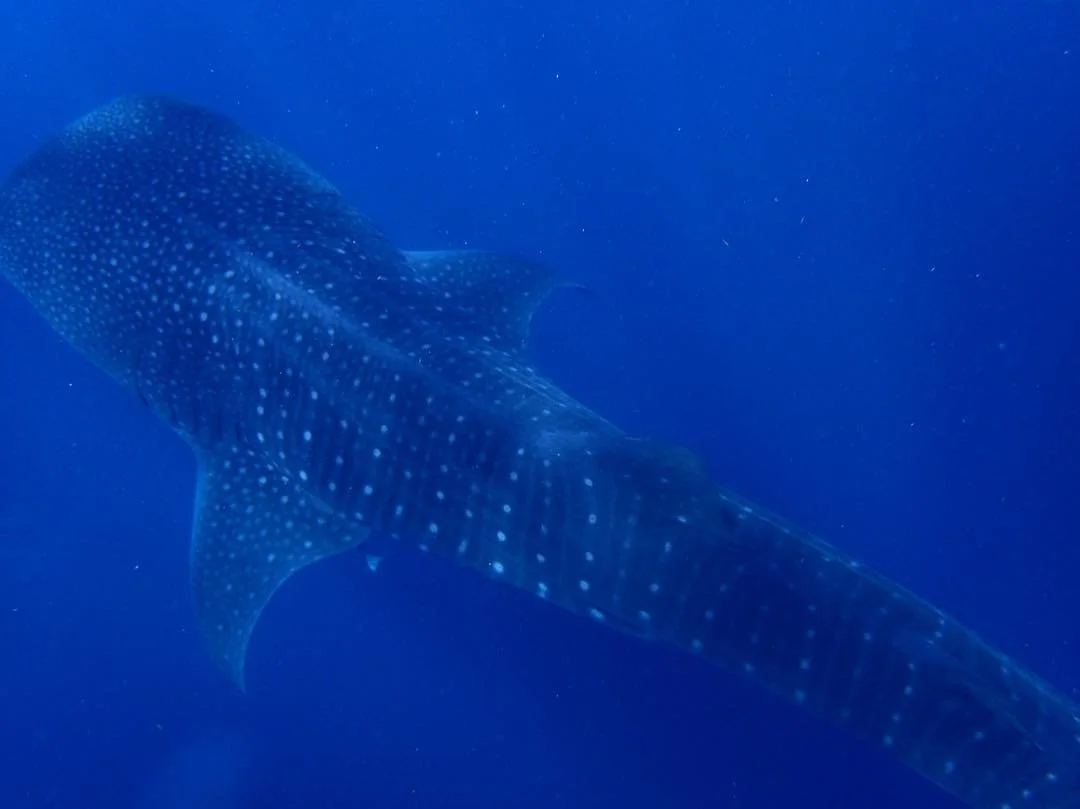
Miles offshore, when no land was visible, the captain scanned the horizon. The glassy, calm surface made it easier to search today. He turned the radio on to listen for other captains, and switched course. Another boat had spotted whale sharks about a mile away. Catching my first glimpse of whale sharks felt magical—seeing the giants gracefully move below the waves, dorsal fins breaking the surface as their caudal fins, swaying gently side to side, propelled them.
I was part of the second group of 3 to jump in the water. It was a workout to keep up with the leviathans—their tail’s rhythmic movement belies their speed. But I was mesmerized by the scene—their grace, the patterns of their skin contrasting against the deep blue, the way their gills expanded and contracted into their bodies; their sheer size. I was glad to see park rangers appear, to inspect boats, observe interactions and ensure minimal disturbance to the sharks.
The whale shark aggregation off the coast of Holbox Island is the largest one there is (that we know about). From July to September each year hundreds of the biggest fish in the sea gather in an area of only a few square miles. Surely, an event of this size would draw attention—one would think.
The gathering was unknown to science until 2006. Meanwhile, shark populations around the globe, including those of whale sharks, are plummeting. Sharks are hunted for their meat and fins, often in areas of the High Seas, and national waters where fisheries management is nearly absent. Climate change, overfishing, plastic pollution, nutrient runoff, and ocean acidification also threaten their ecosystems worldwide. We may be losing species, ecosystems, and occurrences of the natural world like Holbox’s whale shark aggregation before we even have the chance to discover them. Ninety-five percent of the global ocean is unexplored. How much could we be losing that we don’t yet know?
We’ve protected only a tiny sliver of the global ocean –3.08% of it lies in marine protected areas, but only half of that is strongly protected. On paper. A subset of that portion is effectively managed, and has consistent enforcement in practice that conserves and restores critical ecosystems. It’s vital to have models of effective management, to recognize and reward protections not just on statute but physically in the sea.
It’s as important to build a network of those reserves which allows for the interconnection of marine ecosystems, and represents the full range of biodiversity that exists in the ocean. Hence why I was glad to see rangers verify that only 3 people from our boat in Holbox were in the water at any given time although I wanted to spend more time with the sharks. Well-enforced reserves are a rarity.
The acute need for a global system of well-enforced marine reserves motivated me to support Marine Conservation institute’s newest initiative—the Global Ocean Refuge System (GLORES, pronounced glories—a phonetic play to emphasize the initiative’s aim of safeguarding the glories of marine life). The system aims to contain strongly protected areas that meet rigorous science-based standards for protection, representing 30% of each marine biogeographic region by 2030—a threshold recommended by marine conservation biologists.
GLORES will do so by recognizing and rewarding such areas, introducing a new incentive for governments to regulate and enforce protections, and for administrators to implement them effectively. The new award system—equivalent to Oscars™ for ocean protection, coupled with global leadership and action-inducing events like the International Marine Protected Areas Congress, and the Our Ocean Conference (the brainchild of Secretary of State John F. Kerry which continues to spur ocean action globally) can drive growth of strong, effective marine protection to increase at an exponential pace.
Ocean conservation leaders support the initiative. Sylvia Earle, a world-renowned marine explorer, chief scientist of NOAA under President Bush and founder of Mission Blue, has said, “The Global Ocean Refuge System is critical to saving the biodiversity of our oceans… We all should have thought of it a long time ago.” The support of other ambassadors like Leonardo DiCaprio, Oscar™ awardee and ocean advocate could spur the success of GLORES even further.
This year, the European Union will host the Our Ocean Conference in Malta October 5th to 6th. Already, countries and other stakeholders have made good on commitments made at last year’s conference. The international community’s leadership and the propelling force of GLORES can push marine protections to reach a new level. The Malpelo Flora and Fauna Sanctuary, a Colombian MPA and one of 3 inaugural GLORES awardees—reaching platinum status for its strong protections and enforcement—was already expanded to nearly 3 times its size by President Juan Manuel Santos after receiving its GLORES award, on September 14th. For his part, President Santos celebrated the designation of Malpelo as a Global Ocean Refuge and noted that the global recognition advances Colombia’s protection of its biodiversity.
GLORES also recognized Papahānaumokuākea Marine National Monument, the largest U.S. marine reserve, and one of the 5 largest marine reserves in the world, and Tubbataha Reefs Natural Park in the Philippines, a refuge for at least 600 fish species, 360 coral species, 11 shark species and 13 cetacean species. Considering the recent expansion of Malpelo’s Flora and Fauna Sanctuary, the Global Ocean Refuge System now contains more than 1.535 million square kilometers of protected ocean (by surface area) representing 3 distinct biogeographic regions, and half a percent of the global ocean (0.42%). Strong protections within Global Ocean Refuges, the establishment and expansion of more reserves which can be recognized within the system, and concerted global action spurred by leaders like Kerry, DiCaprio, Sir Richard Branson, and conferences like the Our Ocean Conference, can restore the ocean.
The metric for success of GLORES is an unusual though vital one—how well the system can restore abundance already lost, and preserve what’s left of marine biodiversity. Ecological balance, which GLORES helps maintain and rebuild, is crucial to ecosystem services the ocean provides—ocean circulation to temper the climate, production of oxygen, absorption of CO2 among many others. Humans depend in myriad ways on these services the ocean provides, so it is as vital to our survival as to that of marine species that GLORES succeeds.
In the end there will be many benefits from meeting GLORES’ goals—more fish, healthier oceans, beautiful reefs, and an abundance of life. But perhaps the most lasting and meaningful gain will be less tangible—measured in abundance, species diversity, unique ecosystems, and spectacular events of the natural world (like Holbox’s whale shark aggregation) – that we will be able to study, learn from, and experience because strong protections ensure they persist long enough for us to discover them.
Sebastian Nicholls contributes to Marine Conservation Institute’s Global Ocean Refuge System initiative, a plan to protect 30% or more of each of the ocean’s biogeographic regions in well enforced MPAs. Marine Conservation Institute is dedicated to securing permanent, strong protection for the oceans’ most important places – for us and future generations. Learn more about the Global Ocean Refuge System by watching this video. Marine Protection is a primary theme of this year’s #OurOcean Conference organized by the European Union and taking place in Malta October 5th to 6th, 2017.